Anyone Can Be a Programmer
🎧 Listen as a podcast
Table of Contents
I’ve been building software for a decade and a half, and I’ve seen some major transformations in software programming. There is another major transformation happening right now; the use of AI to write code and develop softwares. Popularly known as Vibe Coding: programming by feel. Using AI assited programming, anyone can turn their ideas into software without writing one single line of traditional code. It actually feels magical to be honest. Describing what we want in plain language,becomes fully working website within minutes. Years of syntax memorization, understanding complex alogrithms and frameworks, debugging cryptic errors, seems irrelevant now. Our ideas and domain expertise matter more than our coding background now. AI Tools like Claude and ChatGPT, have changed who can be a programmer and how programming works.
At first glance, this seems revolutionary, a leap in software programming. But is it really the next evolution or are we witnessing a temporary trend. To answer this, we need to first understand historical evolution of software programming.
Evolution of Software Programming #
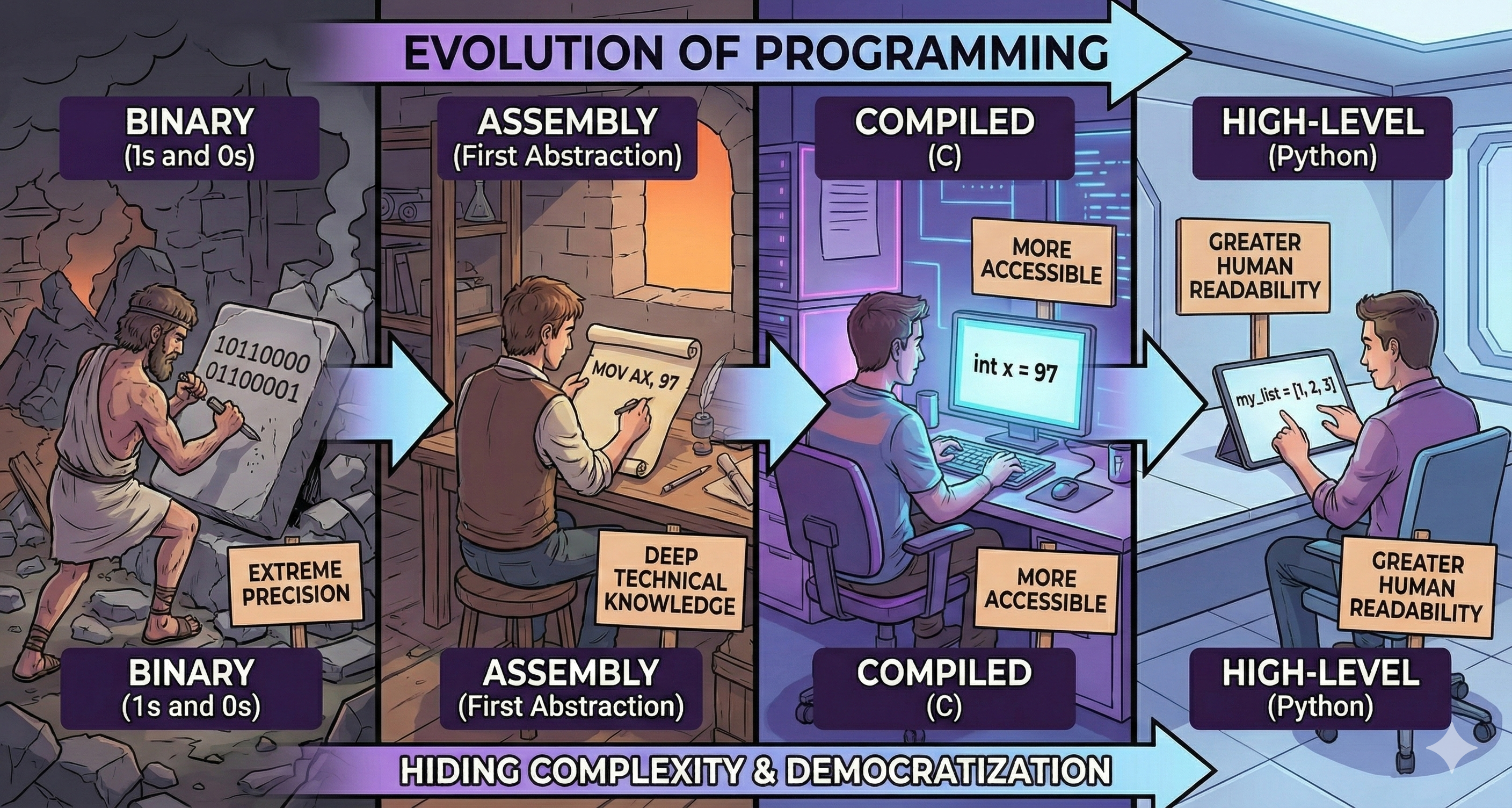
In the beginning, everything needs to written in binary sequences of 1s and 0s. Early programmers had to write instructions like 10110000 01100001, which meant “put the number 97 in this specific memory location.” Every program was an exercise in extreme precision and patience.
Assembly language was our first real abstraction, replacing binary with readable instructions. MOV AX, 97 made more sense than its binary equivalent. Still, creating anything useful required hundreds of these low-level commands. It was powerful but demanded deep technical knowledge.
Then came compiled languages like C. Now we could write int x = 97 and let the compiler figure out the machine code. Each variable declaration replaced dozens of assembly instructions. More people could learn programming because they didn’t need to understand processor registers and memory addresses. This was revolutionary, it let more people participate in creating software.
Languages like Python pushed this even further. They handled memory management, offered intuitive data structures, and let us write my_list = [1, 2, 3] without worrying about the underlying complexity of memory allocation and variable assignment. Each evolution expanded who could contribute to software development.
Notice the pattern? Each evolution made programming more accessible by hiding complexity. Each new layer trusted programmers to work at a higher level of abstraction while automated tools handled the details below. Programming has always evolved towards greater human readability and democratization.
Does Vibe Coding Fit This Evolution? #
On the surface, vibe coding seems like the natural next step.
The Similarities Are Striking #
Higher abstraction: Just as Python developers don’t worry about memory management, vibe coders don’t worry about syntax. They operate at the level of intent focusing on outcomes rather than implementation details.
Increased accessibility: Each programming evolution brought in more people. Assembly welcomed those who couldn’t handle binary. Python welcomed those who found C’s memory management overwhelming. Vibe coding welcomes those who find any traditional syntax intimidating.
Hiding complexity: Every evolution has hidden the complexity of the layer below. Vibe coding hides all syntax, all implementation details, everything except the description of what you want.
The Critical Differences #
Vibe coding looks like it fits perfectly into programming’s evolutionary timeline. But here’s what makes this evolution unique: all previous abstractions were deterministic. AI, however, interprets our intent and generates solutions creatively. But it also introduces entirely new challenges: variability, unpredictability, and the need for human oversight. These are some of the challenges that no previous programming evolution has faced.
The Output In-consistency
Traditional programming layers are deterministic. When Python calls a C function, that function behaves identically every time. Same input, same output. This predictability is the foundation of software engineering.
AI-generated code? It’s different every time. Ask for a “user authentication system” five times, and you’ll get five different implementations. Some might be secure, others might have vulnerabilities. Some might be efficient, others might be resource hogs. The AI is making creative decisions, not following predetermined rules.
This isn’t just variability, it’s fundamental unpredictability. The AI might take shortcuts, skip error handling, or ignore security best practices. It often optimizes for “making it work quickly” rather than “making it work correctly.”
The Input Ambiguity
Traditional languages have syntax rules. Break them, and your code won’t run. This seems limiting, but it’s actually liberating, everyone writes for loops the same way, so everyone can read them.
With vibe coding, there are no rules. One person writes a paragraph explaining their needs. Another writes three words. Someone with security knowledge mentions SQL injection prevention; someone without it doesn’t know to ask. The quality of output directly depends on the quality of input, but there’s no standard for what “quality input” means.
The combination of AI’s creative interpretation and our diverse communication styles creates a dynamic system full of variablities.
Given these significant challenges, we might wonder if Vibe Coding is worth pursuing.
What the Next Evolution Actually Needs #
Abstracting away syntax to focus on intent is the logical next step. The democratization of programming is valuable and inevitable. The productivity gains are real.
But only if we can minimize the non-determinism and align vibe coding with traditional programming principles. The evolution of programming has always maintained certain invariants: predictability, reliability, maintainability. We need structure, standards, and engineering rigor applied to this new paradigm. We need to evolve, not abandon everything we’ve learned.
Here’s what I believe we need: a middle ground where the accessibility of vibe coding meets with the rigor of software engineering. I call it Natural Language Coding. This isn’t just rebranding vibe coding. It’s a fundamental shift in how we think about AI-assisted development. Instead of “programming by feel,” we’re “engineering through natural language.” The difference matters.
This is the evolution that fits programming’s trajectory. Just as Python didn’t abandon C’s performance considerations but abstracted them intelligently, Natural Language Coding doesn’t abandon engineering principles but expresses them differently.
How to perfect the art of Natural Language Coding #
The goal of Natural Langauge Programming is to bring engineering discipline to AI Assisted Programming. To minimize non-determinism and keep things as close as possbile to traditional programming priciples. To bring in accountablity of what we code.
Adopting Software Engineering mindset #
Embracing Vibe Coding means adopting an engineering mindset rather than a “quick fix” mentality. It combines strategic thinking with technical awareness. We’re not just users of AI tools, we’re architects of solutions.
Question everything the AI produces. Start by developing a questioning mindset. When AI generates code, examine it critically. Does it handle edge cases? Is it secure? Will it scale? This isn’t about doubting the AI, it’s about ensuring our solutions are robust. Think of yourself as the quality gatekeeper.
Embrace the “why” behind decisions. Understanding the “why” behind code choices makes us better builders. When the AI suggests an approach, explore the trade-offs. What alternatives exist? What are the implications for performance, maintainability, and security? This knowledge helps us make informed decisions and request better solutions.
Think beyond the immediate problem. Consider the broader context of your solutions. Software doesn’t exist in isolation, it connects with other systems, serves real users, and evolves over time. By thinking systematically, we create solutions that aren’t just functional today but remain valuable tomorrow.
Adopt a security-first mindset. Security thinking is now part of everyone’s toolkit. We validate inputs, protect data, and assume our code will face challenges. This isn’t paranoia, it’s professional responsibility. By building security awareness, we create software that earns and maintains user trust.
Value simplicity and clarity. Embrace simplicity as a design principle. The best solutions are often the most elegant. If the AI generates complex code, we have the power to request cleaner alternatives. Clear, maintainable code is a gift to our future selves and our collaborators.
Following SDLC Principles #
Software Development Lifecycle (SDLC) isn’t just for traditional programmers, it’s a powerful framework that helps us create better software regardless of how we build it. And trust me, following these principles will save you so much headache down the road.
Planning Phase: Start with clarity about what you’re building. Document your product requirements, define success criteria, and identify key stakeholders. This isn’t bureaucracy, it’s setting yourself up for success. When we know exactly what we want to achieve, we can communicate it clearly to the AI. Create test scenarios early: “When this happens, the system should respond this way.” This preparation transforms vague ideas into concrete specifications.
Design Phase: Visualize your system’s architecture. Create the database design and user interface mockups. How will components interact? What’s the user journey? Define your non-functional requirements, performance targets, security standards, accessibility needs. Share these with the AI as foundational context. You’re not just requesting code; you’re architecting a solution.
Development Phase: Craft your prompts strategically. Break complex requirements into clear, logical steps. Instead of “build an app,” try something like: “Create a user registration system with email validation, bcrypt password hashing, and rate limiting for spam prevention.” Precision in equals precision out.
Testing Phase: Testing is where good software becomes great software. Systematically verify functionality, security, and performance. Try edge cases, unusual inputs, and stress conditions. Test across different environments and scenarios. Every bug you catch before deployment is a problem your users won’t face.
Integration and Maintenance: Professional software development includes version control, code reviews, and ongoing maintenance. Commit your code to repositories, document your decisions, and plan for updates. These practices exist because software lives and evolves. AI-generated code needs the same care as hand-written code
The Future of Programming #
We’re standing at a genuine inflection point. The democratization of programming is happening whether we guide it or not. The question isn’t if everyone will be able to create software, but whether that software will be worth using.
Natural Language Coding represents our best path forward. It acknowledges that the barriers to entry should be lower while insisting that the bar for quality remains high. Your domain expertise becomes your programming superpower, but it’s channeled through proven engineering practices.
Think about what this enables. Medical professionals building tools that actually understand clinical workflows. Teachers creating educational software that reflects real classroom needs. Scientists developing research tools without waiting months for IT support. This isn’t just about more programmers, it’s about better software because it’s built by people who deeply understand the problems.
But this future requires all of us to step up. If you’re using AI to generate code, you’re a programmer now. That means taking responsibility for what you build, testing it thoroughly, and ensuring it’s safe for users. By combining AI’s accessibility with engineering rigor, we can build better software faster than ever before. But only if we remember that with great power comes great responsibility.
Ready to Start Building? #
Follow this step-by-step guide. A walkthrough of everything you need to know: choosing the right AI tools, crafting effective prompts, implementing each SDLC stage, and testing strategies that ensure you’re building robust software. It’s a practical roadmap to become a skilled Natural Language Programmer, from very first project to production-ready applications. Happy Programming !!!